
Volume 24
Numbers 1 & 2
In this issue…
From the Editor
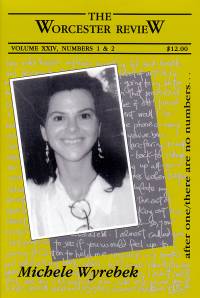
Last year we mourned the death of poet Donald Baker from Parkinson’s disease. He told us, in Volume XX—the issue which in many ways served as his Worcester home-coming—”I am in it (poetry) with all my heart.” This year, we mourn the death, at 42, of another poet, Michele Wyrebek, from complications of her quarter-century war with cancer. Michele was also a poet who was “in it with all her heart.” But, when one is conscious of her young age and the ravages which that twenty-five year war against cancer had taken upon her body, one realizes that for Michele, poetry was her heart, poetry was her body. For example, in the 1990s, Michele read at Del Rossi’s, a restaurant in New Hampshire, on a Sunday afternoon. I know a poet is good when the waitresses stop working and just listen. That afternoon, when Michele spoke, they stopped, but what happened next astounded me; the dishwasher had come out to listen, and then Steve Jones, the chef himself, stopped his prepping, came out of the kitchen into the gallery and stood rapt. Steve Jones, besides loving his cooking, is also a master musician, one of the few good enough at the banjo to have been contracted to play it with a symphony orchestra. Steve Jones was weaned on the humanities; his father taught art at Northfield Mount Hermon. His uncle, a well-known composer. When I gave an oral reading of Canto XXX from Pinsky’s translation of Dante’s Inferno, it was Steve Jones who read the Italian backdrop. When waitresses, dishwashers, and classicist chefs drop work and stand rapt, the poetry is beyond good, it is transcendent.
In October of 2001, Michele Wyrebek wrote about another September reading: “If ever there was a time to affirm the bonds of love and friendship, last month was it…. The music of that day will play in my mind for the rest of my life.” For us the music of Michele’s poetry will play in our minds for the rest of our lives.
And because we too are in this “with all our heart,” we are happy to introduce a new regional voice in this issue, New Hampshire poet Robert Duffy, a Navy veteran who served two tours off the coast of Vietnam on a heavy cruiser. He has been writing poetry since he was a teenager but what gives his work such a distinctive voice is that he composes by ear while he commutes and commits the poem to memory first, and only later writes it down. Because of this unusual method of composition, his poems take on a verbal resonance that stands them apart. When he is not composing, where many of us might be reading other poets, he is listening to them during those long commutes. For other writers, one can see the influences of the great poets as one reads the writers’ poetry, but in Duffy’s case, one hears more than sees how Duffy melds influences of Robert Frost, T.S. Eliot, Dylan Thomas and Wilfred Owen (though Duffy insists it was Siegfried Sassoon, not Owen who influenced him more) into his own unique voice.
And there is much more, the editors have selected over thirty more poems and stories from twenty-five writers across the United States and Australia. Additionally this double issue provides you poetry by the eight winners chosen by Jeffrey Harrison as the best of the 2003 WCPA annual contest.
Finally, as a preview for upcoming issues, we hope to provide a feature on Robert Cormier next fall and a special issue celebrating Worcester’s selection as the host city for the 2005 National Slam Championships.
Rodger Martin
Managing Editor